Access
Registered users have access to their Barnahus’ Hub at: http://hub.barnahus.eu
Supporting documents
The Hub Guidance document provides information about data protection and key considerations for using PROMISE Hub in the appropriate and safest manner. It also provides a template user agreement.
The user guide is a manual for how to record data in the tool.
About Barnahus Hub
The Hub is a collaboration and case-coordination platform developed for the Barnahus Network by Bonigi. It supports professionals from the different agencies involved to document and, where authorised, share relevant information in a structured and controlled way, creating a joint overview of the case. It also provides the infrastructure through which selected structured information can be used for evaluation and quality development.
The Hub provides a shared, structured and secure space where relevant information, decisions and activities can be documented and made available to the professionals who need it. This supports a more coherent overview of the child’s situation and of the response being provided and facilitates information-sharing.
The aim is to make coordination and information-sharing easier, safer and more systematic. By bringing the relevant professionals together around the same case information, the Hub can support joint planning, clearer responsibilities, better follow-up and continuity across the different functions of Barnahus.
This is important not only for professionals, but ultimately for the child, since the Hub supports professionals to work from a shared understanding of the case and a coordinated plan, in accordance with the best interests of the child.
The Hub makes it possible to document the actions and decisions taken across the different agencies involved. This creates a more complete picture of the Barnahus response than information held separately by individual agencies.
An important added value is that the information generated through already existing collaborative practice, such as case management meetings, can also provide the foundation for evaluation and quality development. Rather than creating a separate data-collection exercise alongside everyday work, the ambition is to make relevant information captured through case coordination usable for both purposes.
Languages
The evaluation framework/Hub can be translated into any language. The Barnahus Network can support AI translation of the terminology in the Hub, which the participating country will check and verify, so that it reflects the national terminology accurately.
How to enter a case
The Hub workflow starts from the dashboard. The screenshots below illustrate the current interface; field names and final evaluation fields may change as the framework is finalised. In practice, the steps are expected to be:
1. Open the Case area. From the dashboard, choose Case or Create case. The Case history can also be used to find an existing record.
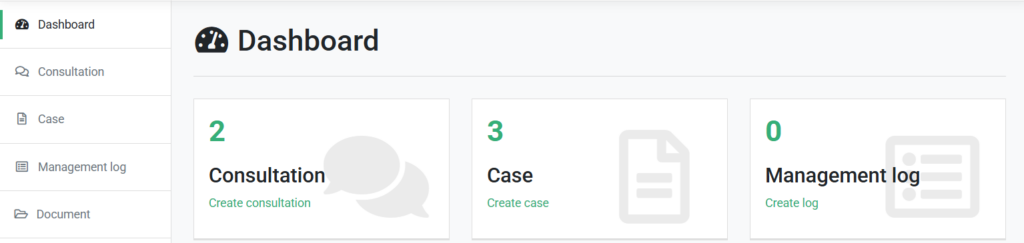
Illustrative screen: selecting a record type from the dashboard.
2. Create or find the case. Start a new case entry or use the Case history filters to locate an existing record. Case-history rows are omitted from the example screenshots.
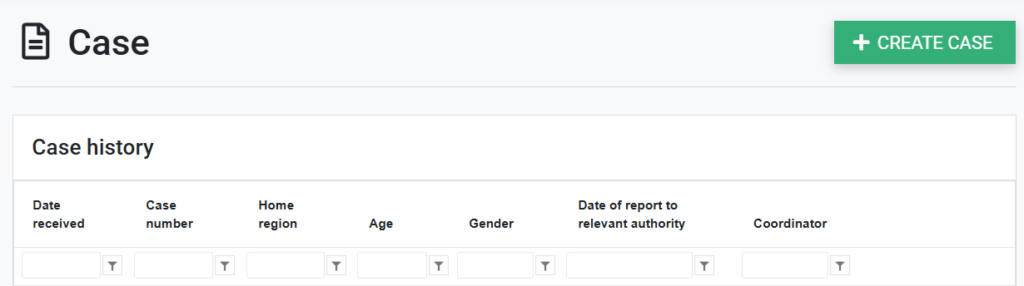
Illustrative screen: the Case area and case search.
3. Complete the structured case fields. Enter relevant dates and select predefined options where available, then save the record. Only fields agreed for the pilot and relevant to the site will be used; the Hub is not intended to hold a full narrative case file or identifying details.
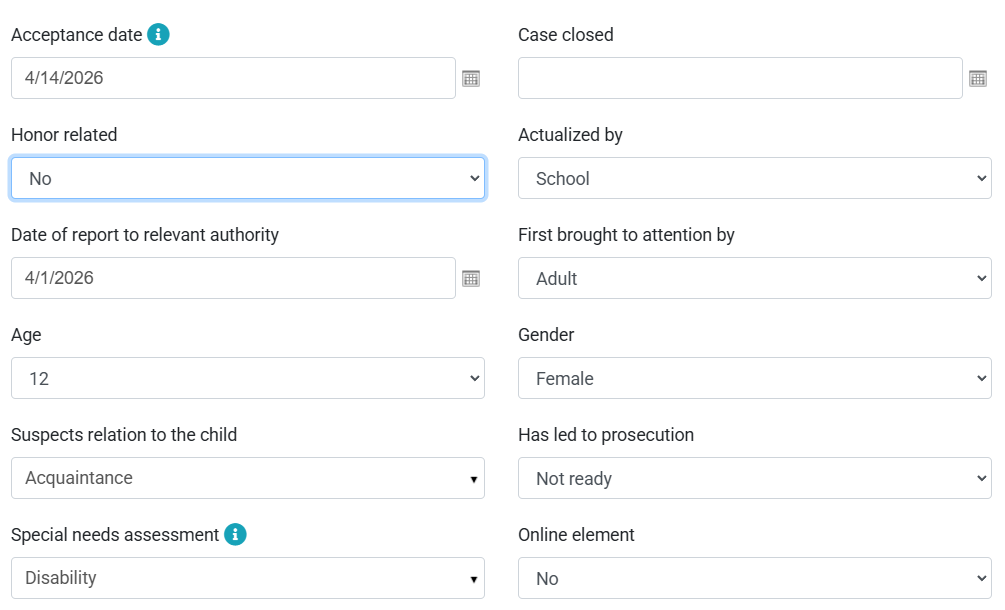
Illustrative screen: structured fields in the case form. Field specifications are provisional.
4. Add key events and multidisciplinary activity as they occur. For example, the team may record a relevant meeting, its date and type, participants, and selected information about the process. Other agreed milestones may include a forensic interview, medical assessment, child-protection action or referral to support, depending on the site’s services and the final fields.
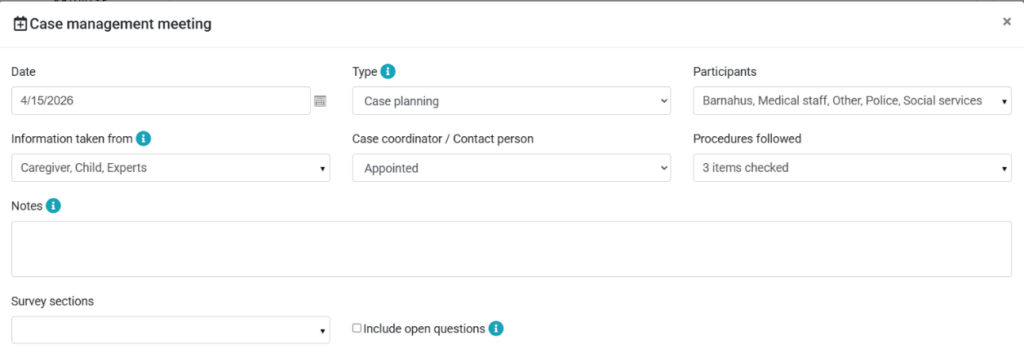
Illustrative screen: recording a meeting linked to the case.
5. Complete any agreed reflection or follow-up fields. At a suitable point, the team may record a short case reflection and available outcome or follow-up information. The exact sequence and responsibility for data entry will be agreed with each site. Around 20 minutes per case is an initial estimate, not a confirmed time requirement; the pilot will test it.
How is the child experience survey integrated into the Hub?
The child experience questions are intended to be collected through a structured survey so that the child’s own views are recorded, rather than a professional’s interpretation of them. Questions focus on the child’s experience—for example, whether they felt informed, listened to, safe and respected, and whether they had opportunities to express their views. The Hub’s Analytics screen currently lists Survey as a topic, as illustrated below. The screenshots do not show the child-facing questionnaire itself, so the precise survey link, workflow and reporting will be confirmed during pilot setup. The timing, method of offering the survey, language and any support provided to children will be agreed locally, taking account of children’s needs, safeguarding and applicable ethical and data protection requirements. Responses should not include names or other identifying details. The pilot will test whether the survey is practical and appropriate in routine Barnahus practice.
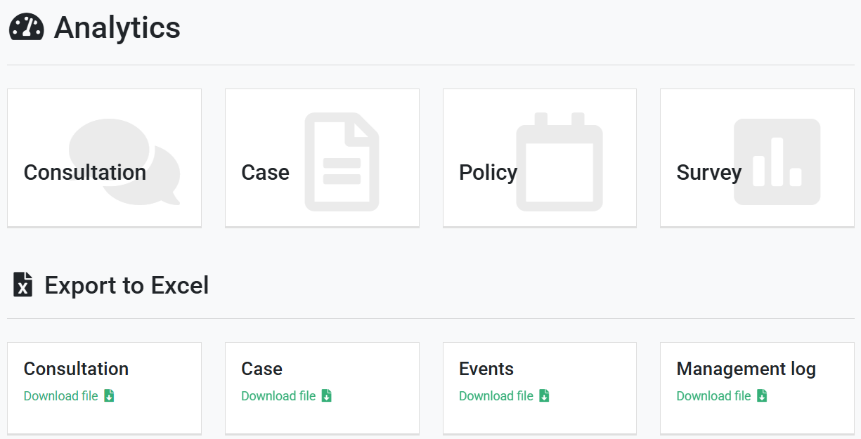
Illustrative screen: the Analytics area includes Survey as a topic. This is not a screenshot of the child-facing questionnaire.
Data protection and confidentiality
The Hub is designed so that names, contact details and other direct identifiers are not entered into the evaluation dataset. Participating Barnahus are asked to enter structured, non-identifiable case information using predefined fields. Staff should not enter names or identifying details in free-text fields. The site-specific setup and data protection review will consider whether combinations of fields could create a risk of indirect identification and what safeguards are needed.
The purpose is to collect information about cases and the Barnahus response, not information identifying the people involved.
The Hub includes security measures such as multi-factor authentication and differentiated access to information.
An ethical and data protection review will take place before data collection begins, including consideration of any requirements specific to participating countries.
Data protection and control
Each participating Barnahus owns and remains in control of the data held in its Hub. Bonigi hosts and operates the Hub and processes the participating Barnahus’ data on its behalf and in accordance with the agreed contractual arrangements and documented instructions. Bonigi does not acquire ownership of the participating Barnahus’ data or independently determine how that data may be used.
Participation in the evaluation does not in itself give Barnahus Network or researchers access to the site’s underlying case data.
The structure and content of the evaluation dataset will be defined based on the Evaluation Framework. It will be agreed and documented with the participating Barnahus.
The Hub collects standardised, non-identifiable information concerning collaboration quality, multidisciplinary case activities, child, family and case characteristics, short case reflections, child and caregiver experiences, and case outcomes and follow-up.
Participating Barnahus will not be expected to collect information that is outside their legal reach, Data Protection Impact Assessment (DPIA) boundaries or operational visibility. Where information cannot be obtained, this is acceptable and may itself provide relevant learning.
Data made available to Barnahus Network will be aggregated and anonymised/non-identifiable and will not contain personal data that can reasonably be used to identify an individual child, caregiver, professional or other person, including through combination with other data.
Before data sharing begins, each participating Barnahus will be informed and consulted about what information is proposed to be shared, with whom, for what purpose and in what form. The detailed arrangements will be agreed and documented.
Contractual safeguards
These principles will be formalised in the contractual documentation with each participating Barnahus. The agreements will confirm the participating Barnahus control of its data and Bonigi’s role in processing and managing that data on its behalf. They will also define the respective responsibilities, permitted processing, security and confidentiality requirements, data-sharing arrangements, and provisions for data access, export, retention and deletion.
Where Bonigi processes personal data on behalf of a participating Barnahus, this will be governed by a Data Processing Agreement and agreed documented instructions from that organisation.
Is ethical approval or a DPA required?
The requirements for ethical review and data protection assessment may differ between countries and according to how the Evaluation Framework and Hub are implemented locally.
The use of Hub does not automatically mean that a separate research ethics approval is required from every participating Barnahus. We will work with each participating site to identify what ethical review or approval is required under the applicable national rules. Where the data are subsequently used for research, the relevant research ethics and data governance requirements will apply.
Where more than one organisation is involved, the parties will clarify the appropriate contractual arrangements before data collection starts. Depending on the actual roles, this may require a Data Processing Agreement, an arrangement between joint controllers, or separate agreements between participating organisations. The correct arrangement must be confirmed for each site rather than assumed to be the same everywhere.
This contents of this page was funded by the European Union. The website and its contents represent the views of the authors only and is their sole responsibility. The European Commission does not accept any responsibility for use that may be made of the information it contains.